Inside the GPU Cluster — How Thousands of GPUs Collaborate to Train a Large Language Model

By Sabyasachi (SK)

In Part 2 of this AI series, we explored how raw data becomes tokens, and how tokens become numerical inputs that flow into a neural network.
Now we go one step deeper — into the engine room of AI training:

👉 How do thousands of GPUs work together to train one model?
👉 Why does training take months, sometimes years?
👉 What makes this process so communication-heavy and complex?

To understand this, we need to imagine what’s happening under the hood during a large-scale LLM training run.

1. The Training Set Is Too Big for Any One GPU

Modern training sets contain:

  • billions of tokens
  • millions of documents
  • thousands of gigabytes of processed text

No single GPU can hold the entire dataset.
No single GPU can hold the full model either.

So the training process is distributed.

How?

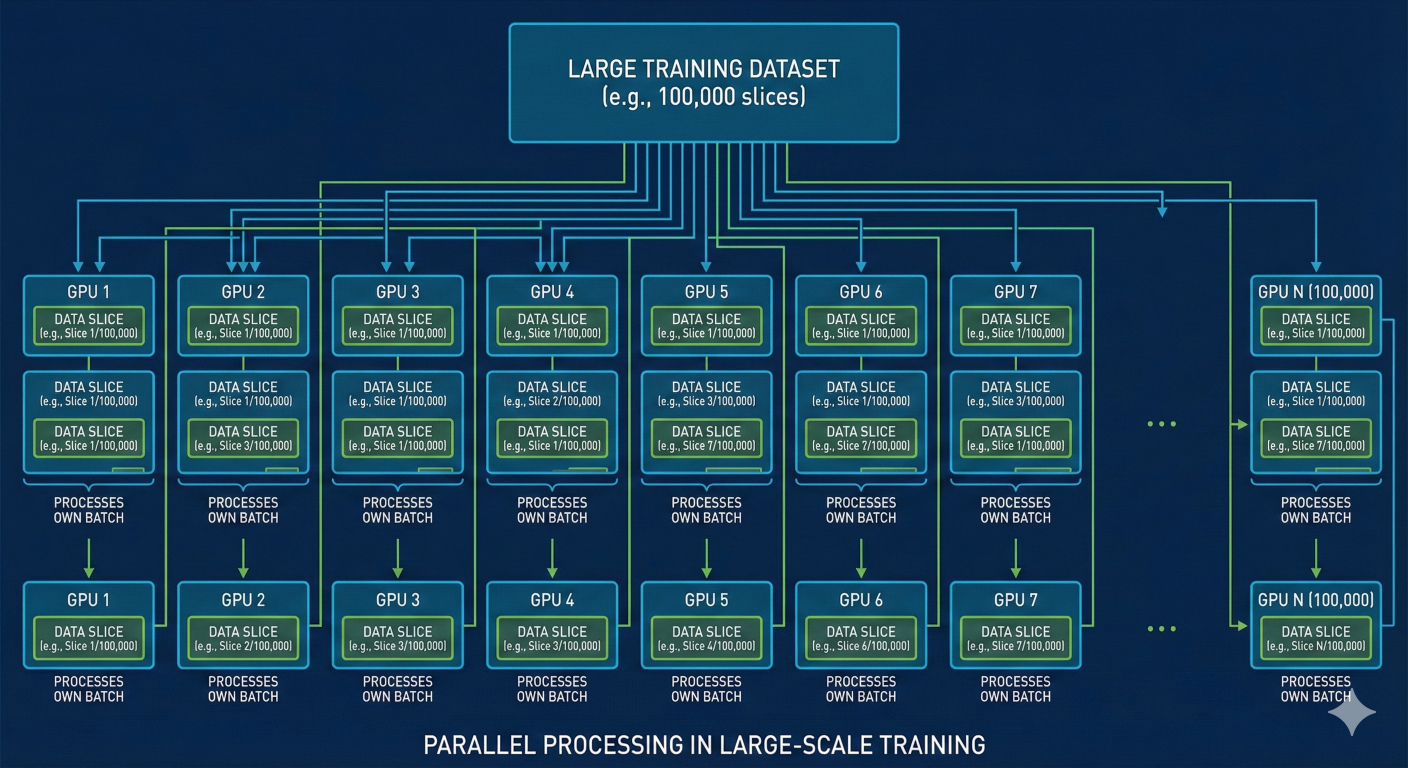
The training set is broken into shards and spread across hundreds or even tens of thousands of GPUs.

Example:
If training uses 100,000 GPUs, each GPU holds a small portion of the data.
Each GPU processes its own slice of the training batch.
This means:

  • No GPU ever sees the entire dataset
  • The global model emerges only when all GPUs collaborate
  • This is the beginning of distributed intelligence.

2. Each GPU Works on Its Own “Compartment” of the Model

Training doesn’t just split the data —
it also splits the model.Large models have:

  • billions of parameters
  • thousands of layers
  • massive matrices
  • enormous attention components
These components are divided across GPUs so multiple GPUs handle different parts of the model simultaneously.This is why GPU clusters accelerate training so dramatically.

2. Each GPU Works on Its Own “Compartment” of the Model

Training doesn’t just split the data —
it also splits the model.Large models have:

  • billions of parameters
  • thousands of layers
  • massive matrices
  • enormous attention components
These components are divided across GPUs so multiple GPUs handle different parts of the model simultaneously.This is why GPU clusters accelerate training so dramatically.

3. Training Is an Interactive, Iterative, Multi-Wave Process

Here’s the part most people never hear:👉 Training is not a one-pass operation.

👉 It is an iterative process with millions of calculation waves.Each wave looks like this:

  1. GPU processes the tokens it’s responsible for
  2. Performs matrix multiplications
  3. Computes partial results
  4. Sends those results to other GPUs
  5. Receives results from peers
  6. Synchronizes
  7. Continues to the next wave
This cycle happens millions of times.That is why:
  • Training takes weeks or months
  • Frontier models take years of ongoing updates
  • GPU megaclusters are required
Every iteration brings the model one microscopic step closer to intelligence

4. Why AI Training Is Extremely Communication-Intensive

Now we reach the heart of this blog.During each training step:
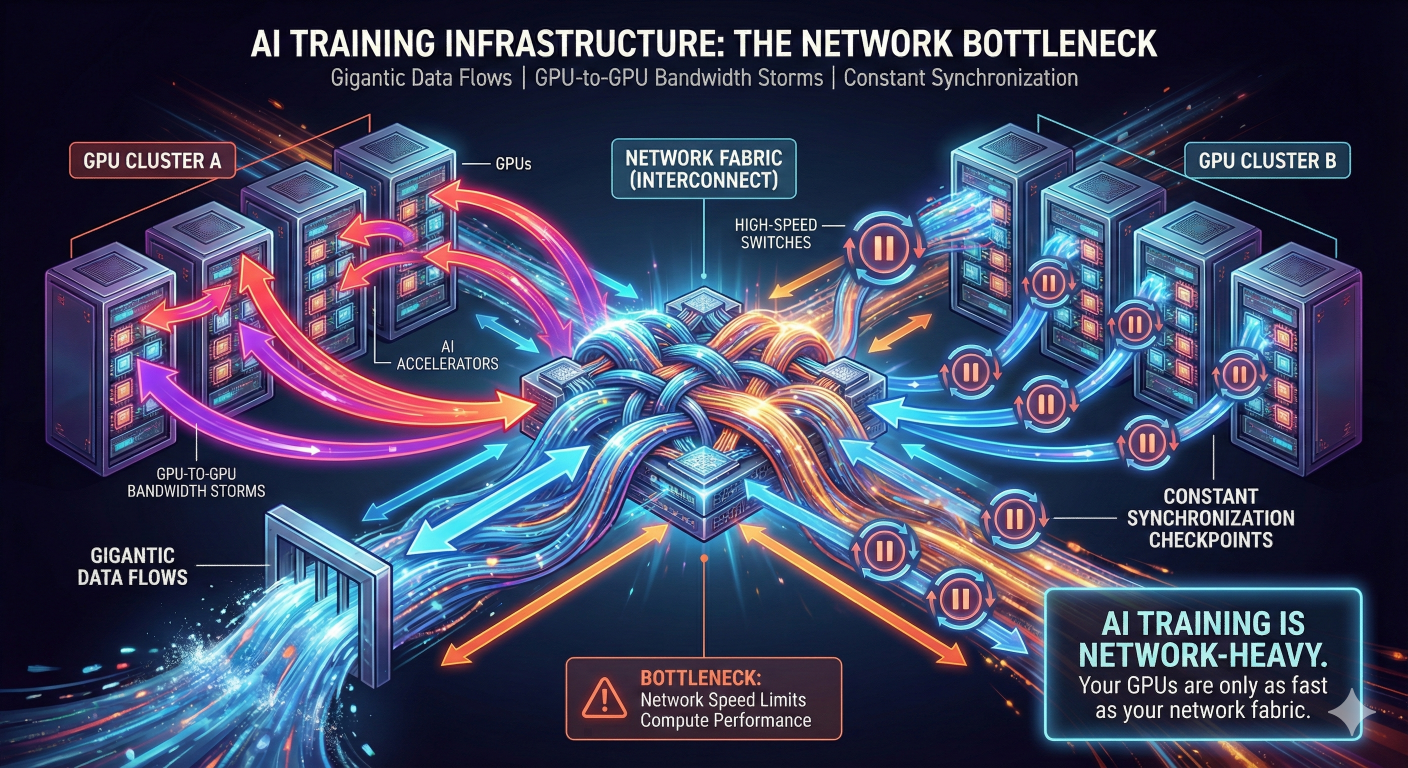
  • every GPU computes its part of the job, then
  • every GPU must share its results with every other GPU
This is called all-to-all communication.It means at specific checkpoints, every GPU says:“Here’s my computation.
Use my output to continue your part of the work.”Then the others respond the same way.This creates:
  • gigantic data flows
  • GPU-to-GPU bandwidth storms
  • constant synchronization checkpoints
This is why AI training is not only compute-heavy —
it is network-heavy.Your GPUs are only as fast as your network fabric.

 5. The Barrier Method — A Critical Concept

Training uses a synchronization strategy called a barrier method.Here’s what it means:

  • All GPUs must finish their current work
  • Before ANY GPU can move to the next step
  • Everyone waits at the “barrier”
  • Once all GPUs arrive, the next wave begins
This ensures correctness — but also makes the process sensitive to:
  • network delays
  • bandwidth bottlenecks
  • GPU failures
  • synchronization lag
If even ONE GPU is slow,
the entire cluster slows down.That’s why companies like NVIDIA, Google, and Meta invest heavily in:
  • high-speed networking
  • NVLink
  • Infiniband
  • custom interconnect fabrics
Without these high-speed networks, training would collapse.

 6. Massive GPU-to-GPU Data Transfer — The Real Bottleneck

During each iteration, GPUs exchange:
  • gradients
  • parameter updates
  • embedding vectors
  • attention components
  • activation maps
And this exchange is huge.Training a frontier LLM can generate:
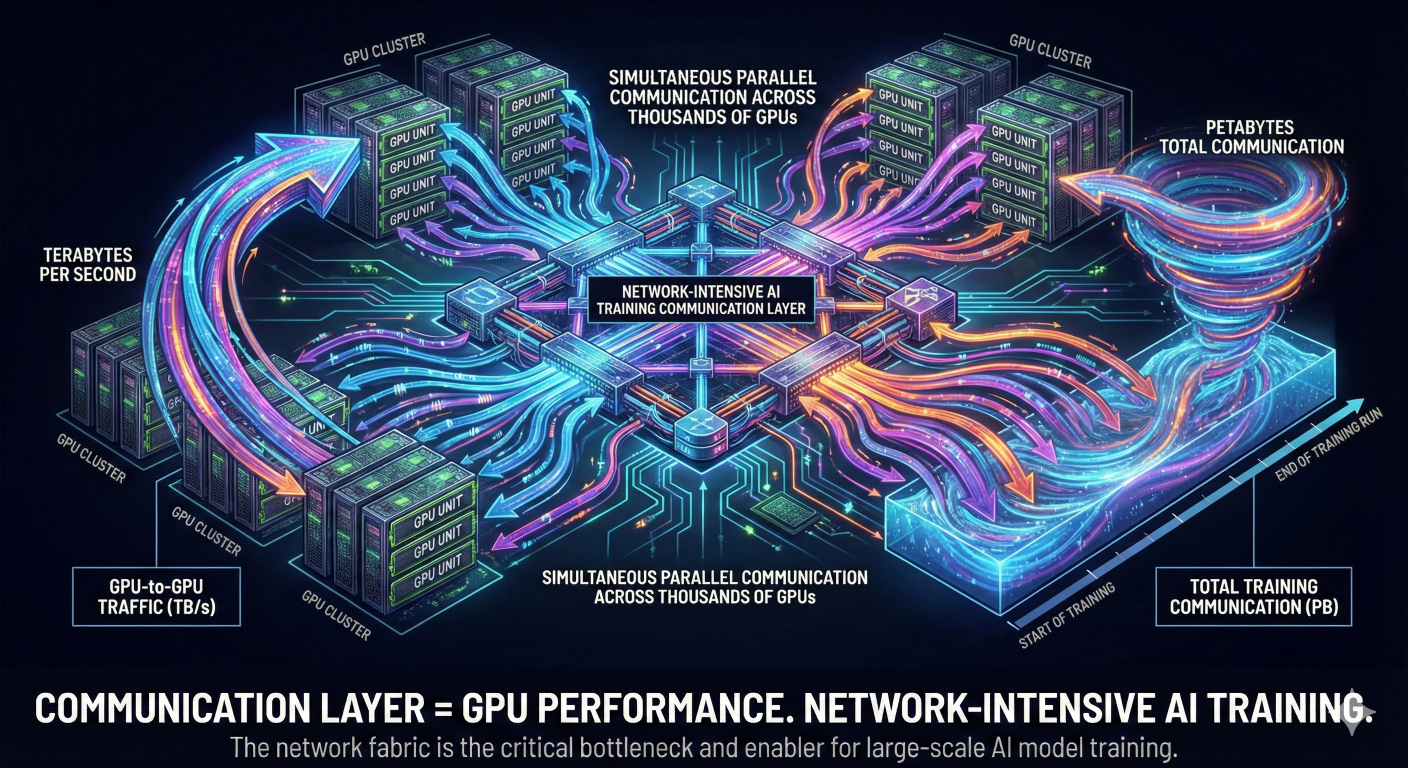
  • terabytes per second of GPU-to-GPU traffic
  • petabytes of total communication over the entire training run
Everything happens at the same time, across thousands of GPUs.This is what we call network-intensive AI training.This communication layer is just as important as the GPUs themselves.

7. Why Training Takes So Long (Real Reason)

People often assume training takes months because:

  • models are big
  • data is massive
  • GPUs are expensive
But the real reason is:👉 The training process has to repeat👉 millions of computational waves👉 across all GPUs👉 while synchronizing constantly👉 exchanging massive amounts of information👉 without making a single mistake.This is why training a new frontier LLM is a multi-month, multi-year engineering effort.A failure in any part of the system:
  • compute
  • memory
  • networking
  • synchronization
  • power
  • cooling
…can ruin training progress.

8. What Comes Next in This Series

Now that we understand:
  • how GPUs split data
  • how they split the model
  • how they synchronize
  • how they exchange results
  • how communication becomes the bottleneck
We are ready to explore the next chapter:⭐ How do we design networks that can handle these massive flows?
⭐ How does GPU networking actually work?
⭐ What technologies allow GPUs to talk at trillions of bytes per second?
⭐ And how does all this affect AI architecture in real datacenters?This will be the topic of Part 4: AI Networking — How We Move Data at Extreme Speed Between GPUs.Stay tuned — the series is about to get even more interesting.

Sabyasachi
Network Engineer at Google | 3x CCIE (SP | DC | ENT) | JNCIE-SP | SRA Certified | Automated Network Solutions | AI / ML (Designing AI DC)